


Community
Elmet Trust Heritage Day at Brier Hey Pottery
Mytholmyroyd
September 21, 2025
TIME:
10:00am
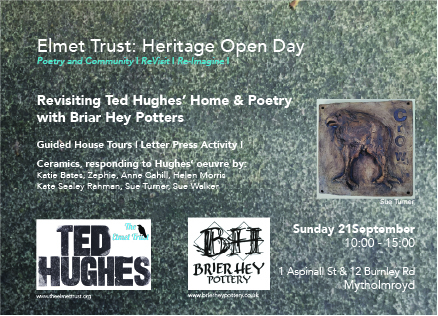
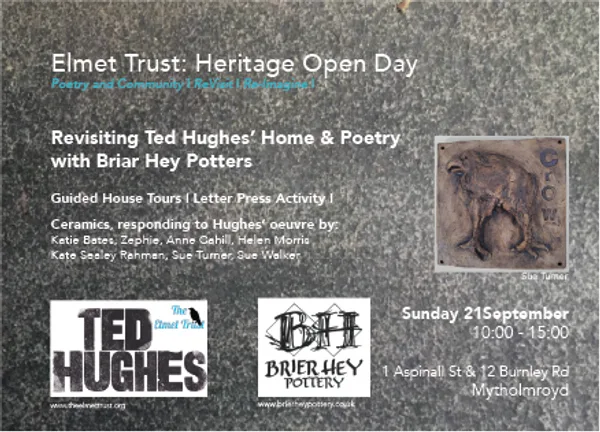
Visit Brier Hey Pottery to see ceramic responses to the work of Ted Hughes. Members of Brier Hey Pottery have created work in response to Hughes' poems.
Brier Hey Pottery usually opens its doors only twice a year for Hebden Bridge Open Studios, so this is also an excellent opportunity to see inside the studio.
21 Burnley Rd,
Mytholmroyd,
HX7 5AB
Find full access information at the link below.
For the Heritage Open Day, the Elmet Trust and invite you to come and explore the home of a key figure in our literary heritage, Ted Hughes. Celebrating Hughes’ Heritage beyond 1 Aspinall Street, potters at Brier Hey are joining our 2025 Open Day! Katie Bates, Anne Cahill, Helen Morris, Sue Turner, Sue Walker, Zephie, and guest-potter Kate Sealey Rahman are exhibiting responses to Hughes poetic imagery in clay. You can visit their work, by walking along the Rochdale Canal for five minutes from 1 Aspinall Street.
We are hugely grateful to Brier Hey for opening their studio at 21 Burnley Road, Mytholmroyd. A rare occasion!
You can also take Hughesian Heritage away with you. Join David Mullin on to top floor of 1 Aspinall Street, making free poetry postcards and bookmarks, with the magic of a Letter Press.
We will also make poetry come alive, via house tours, led by Hughes experts, Dr Ruth Crossly, and Dr David Rudrum.
Ted’s House is where Ted Hughes was born in 1930 and lived until he was eight. The house has been lovingly restored in 1930s style to capture the ambience of the era when Hughes lived there. The surrounding countryside is rich in wildlife, and many of Hughes' memories and experiences in the environs of Aspinall Street and the wider Calder Valley are captured in his collections of poems, Remains of Elmet (1979) and Elmet (1994).Hughes described the experience of looking out of the window of his bedroom onto the Zion Chapel in the poem 'Mount Zion'. The Chapel is long gone, but Zion Terrace remains, its name a reminder of more God-fearing times. In ‘The Rock’, an autobiographical piece about his early childhood, Hughes writes about Scout Rock, whose cliff face provided ‘both the curtain and back-drop to existence‘. The area continued to be a powerful source of inspiration in his poetry long after he had left Yorkshire. Come along on Sunday 21st September and experience a rare opportunity to learn how the spaces and memories in the house connect with several Hughes poems set there.
.png)
.png)



.png)

Follow us


